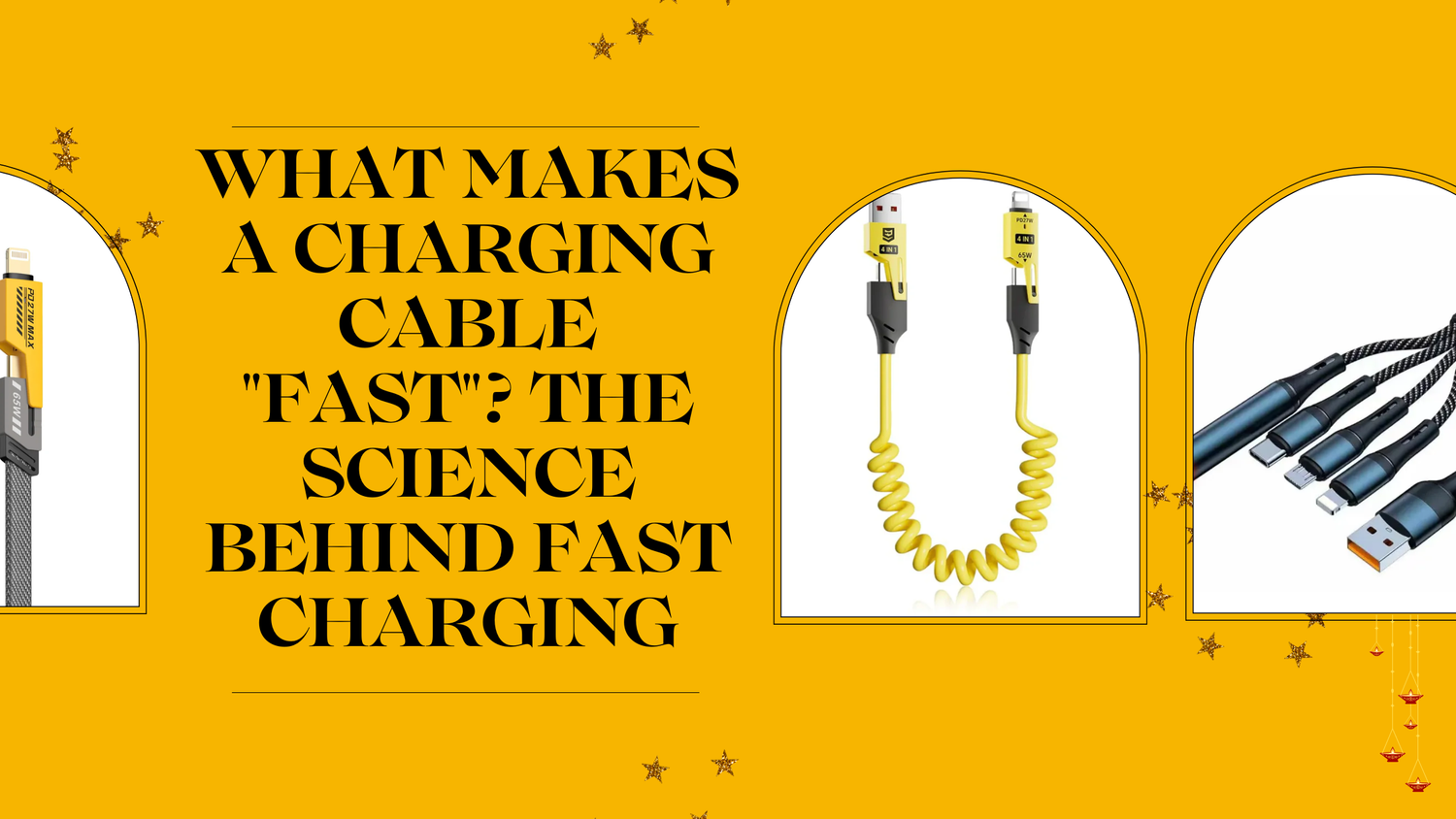
You've no doubt heard about it on the box "Fast Charging Cable" and wondered, "How is this different from the cable I already have? They look the same. They are plugged in the same way. But what is going on inside?
In fact, every time you connect your mobile phone, science is happening. Once you understand it, you will never view a charging cable in a similar light again.
Let's discuss it simply, clearly and honestly.
First, what does "Fast Charging" actually mean?
Fast charging is not magic. It's physics.
Every time you charge your phone, electricity flows from a power source (your wall adapter or power bank), through the cable, and into your device's battery. The speed of that process depends on one key measurement: Watts (W).
Watts = the total amount of power being delivered to your device per second.
A standard old-style charger delivers around 5 Watts. A fast charging cable + charger combo can deliver anywhere from 18W to 100W or more. That's why your phone can go from 10% to 60% in 30 minutes instead of two hours.
The three numbers that control charging speed
To understand fast charging, you need to know three terms. Don't worry — they're simpler than they sound.
1. Voltage (V) — The "Pressure"
Think of electricity like water flowing through a pipe. Voltage is the water pressure. More pressure = more force pushing electricity toward your battery.
Standard charging uses 5 Volts. Fast chargers bump this up to 9V, 12V, or even 20V to push more power through faster.
2. Amperage (A) — The "Flow"
If voltage is pressure, amperage is how much water is actually flowing through the pipe at once. A regular cable might carry 1 Amp. A fast charging cable is built to carry 3A or even 5A without breaking a sweat.
Cheap cables use thin internal wires that can only handle low amperage — that's why they charge slowly even with a fast charger.
3. Wattage (W) — The "Total Power"
Watts are simply Volts × Amps. This is the number that matters most for charging speed.
The simple rule: Higher wattage = faster charging. But all three your charger, your cable, and your device need to support it.
Why is your cable the weakest link?
Here's something most people don't realize: your charger and phone can both support fast charging, but a bad cable will slow everything down.
Imagine a 100-lane highway (your fast charger) feeding into a single-lane road (a cheap cable). All that power has nowhere to go fast. The cable becomes the bottleneck.
Here's what makes a fast charging cable different on the inside:
1. Copper Wire Thickness (Gauge)
Fast charging cables use thicker copper wires inside. More copper = less electrical resistance = electricity flows faster and with less heat. Cheap cables use thin or aluminum wires that create resistance and slow the charge.
2. Cable Length
Longer cables = more resistance = slower charging. If speed matters, stick to 1 meter or shorter. A 3-meter cable might be convenient, but it's quietly stealing your charging speed.
3. Connector Quality
The metal connectors at both ends of a cable wear down over time. Reinforced connectors (made from aluminum or steel) maintain a tight, consistent connection — which means stable, fast power delivery. Weak connectors loosen and cause power interruptions.
4. The E-Marker Chip
For cables that support 100W or more, there's a tiny chip built into the USB-C connector called an E-Marker. This chip communicates with your charger and device, telling them "I'm rated for high power — it's safe to go fast." Without it, your charger will automatically cap the speed for safety, even if your phone and adapter support higher wattage.
How does your phone and charger "Talk" to each other?
Fast charging isn't one-sided. It's actually a conversation.
As soon as you connect your phone, your charger and phone exchange information very quickly (in milliseconds) and do the following calculations:
- What is the maximum voltage that the device is able to withstand?
- What's the maximum current it can accept right now?
- What fast charging protocol does it support?
Based on this negotiation, both sides agree on a power level. This means that if any of the charger, cable, or phone does not support high power, they'll do the slowest common mechanism.
That is why fast charging an old phone is safe. The phone only says 5W, and the charger says "I can only handle 5W.
Fast charging protocols: USB-PD vs. Quick Charge
Not all fast charging is the same. There are different "languages" chargers and devices use to negotiate power. The two most common:
1. USB Power Delivery (USB-PD)
The most universal standard. Used by iPhones, Samsung Galaxy, Google Pixel, laptops, tablets, and more. It can scale from 5W all the way to 240W, making it the most flexible protocol available today.
2. Qualcomm Quick Charge (QC)
The most widely used fast charging standard across Android devices with Snapdragon processors. Quick Charge 3.0 and 4.0 are common in mid-range and premium Android phones.
Important: If your charger and phone don't share the same protocol, they'll default to basic 5W charging even if both technically support fast charging. Always pair a compatible cable + charger + device.
The 80% rule: Why charging slows down at the end
You've probably noticed this: your phone charges from 0% to 80% really quickly, then crawls from 80% to 100%.
This is completely intentional — and it's protecting your battery.
Here's what happens:
Stage 1 (0–80%): Full Speed When the battery is low, it can safely accept a large amount of current. This is the "fast fill" phase where you see the biggest jumps in percentage.
Stage 2 (80–100%): Slow Trickle As the battery fills up, internal resistance rises. Pushing full power at this stage generates excess heat, which damages battery cells over time. So your phone deliberately slows the charge down to protect its long-term health.
The last 20% can sometimes take as long as the first 80%. That's not a flaw — it's smart battery management.
Does fast charging damage your battery?
This is one of the most common concerns and it's a fair one.
The short answer: a quality fast charging cable used correctly will not meaningfully damage your battery.
Modern phones have sophisticated power management systems that control exactly how much current flows in. Your device won't "accept too much" power — it takes only what it needs, when it needs it.
What does cause battery wear over time:
- Excessive heat during charging (caused by cheap, low-quality cables)
- Leaving your phone at 100% for extended periods
- Repeatedly charging in very hot environments
A quality fast charging cable actually reduces heat compared to a cheap slow cable, because it delivers power efficiently without resistance buildup.
What to look for in a fast charging cable?
Now that you understand the science, here's what actually matters when choosing one:
✅ Wattage rating — Does it match or exceed your charger's output?
✅ Amperage support — Look for 3A minimum; 5A for high-power (60W+) devices
✅ Cable length — 1m for speed, up to 2m if convenience matters more
✅ Braided exterior — More durable, better heat resistance, tangle-free
✅ E-Marker chip — Essential for 100W+ charging (usually USB-C to USB-C cables)
✅ Compatible protocol — USB-PD or Quick Charge, matching your device
❌ Avoid: Unmarked cables with no wattage specs, cables under ₹100 from unknown brands, cables with rubber-only casing and no reinforcement
Why does a 3-in-1 fast charging cable make even more sense now?
Once you understand fast charging, the value of a 3-in-1 charging cable becomes even clearer.
A good 3-in-1 cable — with USB-C, Lightning, and Micro-USB connectors, built to fast charging standards means:
- One cable charges your iPhone, Android phone, earbuds, and tablet — all at full speed.
- No compromising on charging rate just because you're using a multi-connector cable.
- Fewer cables to carry, fewer cables to lose, and less clutter at your desk or in your bag.
The key is making sure the 3-in-1 cable you choose is actually built for fast charging with proper gauge wiring, reinforced connectors, and wattage ratings clearly labeled.
The bottom line
Fast charging isn't just a marketing word. It's the result of real engineering: thicker copper wires, higher voltage and amperage, smart protocols that let your charger and phone negotiate power safely, and quality connectors that don't waste energy as heat.
Your cable is not just a wire. It's the bridge between your charger and your battery and the quality of that bridge determines whether you're charging at full speed or crawling along on a slow lane.
Choose a charging cable that's built right, and your device will thank you every single morning.
Frequently Asked Questions
Q.1: Can any USB-C cable fast charge my phone?
Ans. USB-C is just a connector shape; not all USB-C cables support fast charging. Check for wattage and amperage ratings on the cable itself.
Q.2: Does using a higher-watt charger than my phone supports damage it?
Ans. Your phone will only draw the power it's designed for. A 65W charger on a 20W phone simply delivers 20W.
Q: Why does my fast charger charge slowly with one cable but fast with another?
Ans. The cable is likely the bottleneck. Cheap cables with thin wires can't carry the current your charger is trying to deliver. Upgrade to a properly rated cable.
Q: Is it safe to charge overnight with a fast charger?
Ans. Yes, with a quality cable and charger. Your phone automatically reduces power after reaching 80–100%, so overnight charging with a good setup is safe.
Q: What's the fastest charging speed for smartphones in 2026?
Ans. Some Android flagships now support 100W+ charging. iPhones currently top out around 27W with USB-C. Always use the charger and cable rated for your specific device for best results.